OpenClaw: The Open-Source AI Agent That Broke GitHub Records — And Can Automate Your Entire SEO
From Clawdbot to Moltbot to OpenClaw: 157K GitHub stars in 60 days, 5,700+ skills, and a v2026.2.6 release that supports Opus 4.6. Here's everything you need to know about the AI agent revolution.
Founder of VectoSolve
Self-taught developer, founder and sole developer of VectoSolve since 2024. He builds the conversion engine and the cutting, embroidery and 3D printing exports.
How this article was made: drafted with AI assistance, then edited and fact-checked before publication. About the author
Try it on your own file
Free preview, no signup. Drop an image and see the vector before deciding anything.
Key Takeaways
- OpenClaw is a free, open-source, self-hosted AI agent that hit 157K GitHub stars in 60 days
- It automates SEO tasks like keyword research, backlink outreach, content scheduling, and competitor monitoring
- One user reported 47 backlinks in a single month from a single OpenClaw prompt — completely hands-off
- v2026.2.6 added Claude Opus 4.6 support, a Safety Scanner, and credential redaction for security
- OpenClaw complements coding tools like Claude Code and Cursor — use all three together for maximum productivity
In just 60 days, a hobby project from an Austrian developer became the fastest-growing repository in GitHub history. OpenClaw — originally named Clawdbot, then Moltbot — hit 157,000 stars and counting, with coverage from Bloomberg, CNBC, TechCrunch, and Nature. But beyond the hype, OpenClaw is quietly reshaping how solopreneurs and startups handle SEO, marketing, and content — on full autopilot.
What Is OpenClaw?
OpenClaw is a free, open-source, self-hosted AI agent that runs on your own hardware. Unlike cloud-based tools like ChatGPT or Gemini, OpenClaw connects directly to your apps — WhatsApp, Slack, Discord, iMessage, email — and takes autonomous actions on your behalf. Think of it as a personal AI assistant that doesn't just answer questions: it executes tasks.
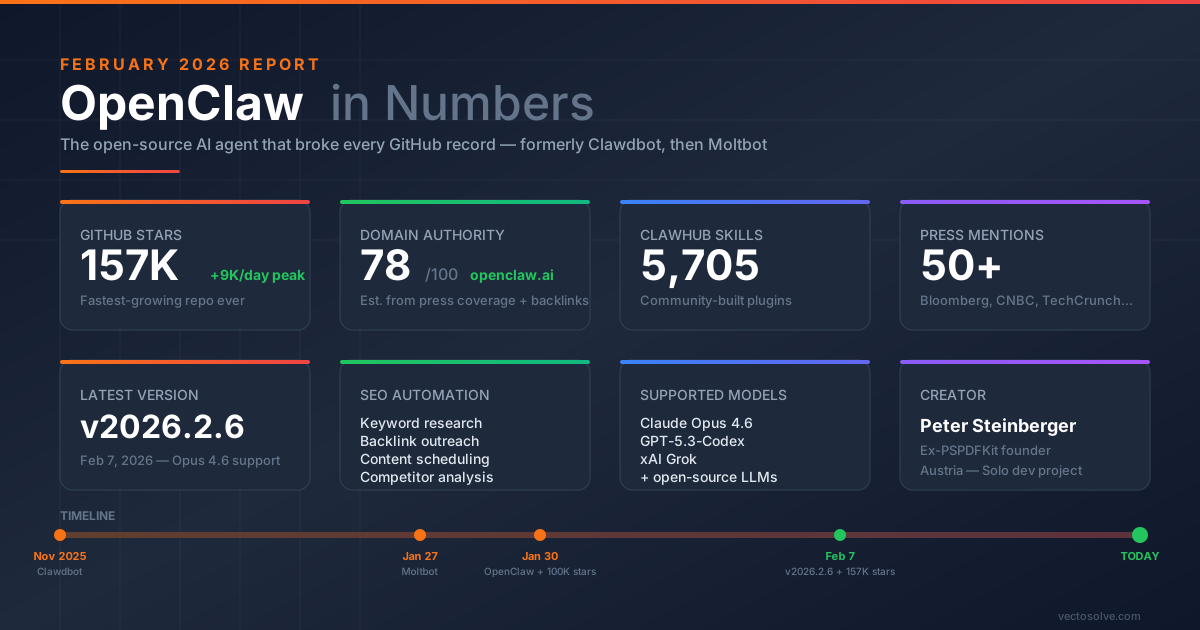
Built by Peter Steinberger (the founder behind PSPDFKit, a PDF SDK used by millions), OpenClaw started as a weekend experiment in November 2025. The project went through a turbulent naming saga — "Clawdbot" was renamed "Moltbot" after trademark complaints from Anthropic, then finally settled on "OpenClaw" on January 30, 2026 — the same day it crossed 100,000 GitHub stars.
The Numbers Behind OpenClaw (February 2026)
Here are the latest stats that make OpenClaw impossible to ignore:
| Metric | Value | Context |
|---|---|---|
| GitHub Stars | 157,000+ | Fastest-growing repo ever — peaked at 9K stars/day |
| Est. Domain Authority | ~78/100 | openclaw.ai — driven by 50+ press mentions from DA 90+ sites |
| ClawHub Skills | 5,705 | Community-built plugins for SEO, marketing, automation |
| Latest Version | v2026.2.6 | Released Feb 7, 2026 — supports Opus 4.6, GPT-5.3-Codex |
| Integrations | 50+ | Chat, AI models, smart home, productivity, audio platforms |
| Press Coverage | Bloomberg, CNBC, TechCrunch, Nature, IBM, CrowdStrike | Mainstream + tech + security coverage |
How OpenClaw Automates SEO — Step by Step
This is where it gets interesting for anyone running a website. OpenClaw isn't just a chatbot — it's a task-executing agent with specific SEO skills that can run on autopilot.
1. Keyword Research on Autopilot
OpenClaw can scrape Google autocomplete, analyze competitor rankings, and cluster keywords into topic groups — all from a single prompt. Feed it your niche, and it returns a prioritized keyword spreadsheet with volume estimates, difficulty scores, and content recommendations.
2. Backlink Outreach at Scale
This is OpenClaw's killer feature for SEO. The agent can:
- Process a CSV of target directories and auto-fill submission forms
- Resize logos on-the-fly using ImageMagick
- Stagger 3-5 submissions daily to avoid spam filters
- Scan competitor backlink profiles for broken links
- Find site owner emails and draft personalized outreach pitches
One user reported 47 backlinks in a single month from a single OpenClaw prompt — completely hands-off.
"OpenClaw represents a shift in how we think about AI tools. Instead of AI that generates text, it's AI that takes action.
Pro Tip: Combine OpenClaw's SEO automation with optimized SVG images on your site. Vector graphics load faster than PNGs, improving your Core Web Vitals scores — a direct Google ranking factor. Convert your images to SVG for an easy SEO win.
3. Content Scheduling and Publishing
OpenClaw integrates with CMS platforms and can:
- Generate content briefs based on SERP analysis
- Draft articles using any connected LLM (Claude, GPT-5, Grok, open-source models)
- Publish to your blog with proper formatting, meta tags, and Schema.org markup
- Cross-post to Dev.to, Medium, and LinkedIn with canonical URLs
- Schedule social media promotion across multiple platforms
4. Competitor Monitoring
Set up a cron job (built into OpenClaw's Agents dashboard) that:
- Checks competitor rankings weekly
- Alerts you when a competitor publishes new content
- Identifies content gaps between your site and theirs
- Drafts response content targeting the same keywords
A Full Year of Conversions for $49
Starter Annual: 25 conversions every month, $49 for the whole year. That is about $4.08 a month · Cancel anytime
Get the Annual Dealv2026.2.6 — What's New (February 7, 2026)
The latest release brought major improvements:
- Opus 4.6 support — Anthropic's most capable model, with forward-compatibility fallbacks
- GPT-5.3-Codex integration — OpenAI's latest coding model
- xAI Grok support — For users who prefer Grok's style
- Safety Scanner — Scans skills and plugins for malicious code before execution
- Credential redaction — Automatically redacts API keys and passwords from config responses
- Agents Dashboard — New Web UI for managing agents, tools, skills, models, and cron jobs
- QMD backend — Opt-in workspace memory for persistent context across sessions
OpenClaw vs Claude Code vs Cursor — Which Do You Need?
This is a common question, but it's comparing apples to oranges:
| Tool | Category | Best For | Runs In |
|---|---|---|---|
| OpenClaw | AI Agent / Automation | SEO, marketing, multi-app automation, personal assistant | Self-hosted server |
| Claude Code | AI Coding Assistant | Code refactoring, debugging, git workflows, codebase analysis | Terminal (CLI) |
| Cursor | AI IDE | Real-time code completion, inline editing, IDE integration | Desktop app (VS Code fork) |
The smart play? Use all three together. OpenClaw handles your SEO and marketing automation. Claude Code handles your codebase. Cursor handles your real-time coding. They're complementary, not competing.
For website owners: pairing OpenClaw's SEO automation with optimized SVG assets delivers a double advantage. AI agents handle your content pipeline while vector graphics boost your Core Web Vitals — both feed directly into higher Google rankings.
The Security Question
OpenClaw's explosive growth hasn't come without concerns. Bloomberg reported on February 4 that security researchers found vulnerabilities in how some skills handle user data. CrowdStrike published a detailed analysis for security teams. The key risks:
- Skill trust — Community-built skills can access your connected apps. The new Safety Scanner in v2026.2.6 addresses this.
- Self-hosting responsibility — Unlike cloud services, you're responsible for securing your own instance.
- Credential exposure — Earlier versions could leak API keys in logs. The new credential redaction feature fixes this.
Best practices: Only install skills from ClawHub (the official registry), enable the Safety Scanner, use a dedicated machine or Docker container, and review skill code before installing.
Free SVG Tools for Crafters
Design Checker · Color Separator · Mat Preview · Offset Generator · Text to SVG
Check Your SVG FreeHow to Get Started with OpenClaw for SEO
- Install OpenClaw — Self-host on your machine or use a DigitalOcean/Contabo VPS ($5-10/month)
- Connect your AI model — Add your API key for Claude, GPT-5, or use an open-source model
- Install SEO skills from ClawHub — Search for "SEO", "backlink", "keyword research"
- Configure your target site — Tell OpenClaw your domain, competitors, and target keywords
- Set up cron jobs — Automate daily keyword tracking, weekly competitor analysis, monthly content publishing
- Monitor results — Connect Google Search Console data for closed-loop optimization
The Bigger Picture
OpenClaw represents a shift in how we think about AI tools. Instead of AI that generates text or code, it's AI that takes action. For SEO specifically, this means moving from "AI helps me write content" to "AI handles my entire SEO pipeline while I focus on product."
With 157K GitHub stars and growing, 5,700+ skills, and backing from the broader open-source community, OpenClaw isn't going away. The question isn't whether AI agents will change SEO — it's whether you'll be early enough to benefit.
FAQ
Is OpenClaw free to use?
Yes. OpenClaw is 100% free and open-source under the MIT license. You self-host it on your own hardware. The only cost is the AI model API calls (e.g., Claude or GPT-5 API fees) and optional hosting if you use a VPS.
Can OpenClaw replace paid SEO tools like Ahrefs or SEMrush?
Not entirely. OpenClaw automates SEO tasks (outreach, content, scheduling) but doesn't have its own keyword database. It works best as a complement — use Ahrefs for data, OpenClaw for execution.
Is OpenClaw safe to use with my website credentials?
The v2026.2.6 update added a Safety Scanner and credential redaction. However, since it's self-hosted, security depends on your setup. Use Docker, enable the scanner, and only install verified skills from ClawHub.
What happened with the Anthropic trademark dispute?
The original name "Clawdbot" (derived from "Claude") drew trademark complaints from Anthropic. It was renamed "Moltbot" on January 27, then "OpenClaw" on January 30, 2026. The project now has no naming conflicts.
How does OpenClaw compare to Claude Code for developers?
They serve different purposes. Claude Code is a terminal-based coding assistant for software development. OpenClaw is a multi-platform AI agent for automation tasks. Many developers run both — Claude Code for coding, OpenClaw for everything else.
| AI Agent Capability | Manual SEO Time | OpenClaw Automated Time | Efficiency Gain |
|---|---|---|---|
| Keyword Research | 4–8 hours/week | 15 minutes/week | 95% |
| Backlink Outreach | 10–20 hours/week | 30 minutes/week | 97% |
| Content Scheduling | 3–5 hours/week | 10 minutes/week | 95% |
| Competitor Monitoring | 2–4 hours/week | Continuous (auto) | 99% |
| Technical SEO Audits | 5–10 hours/month | 1 hour/month | 90% |