SVG vs PDF for Print: Which Format Gets Better Results? (2026)
Sending files to a printer? Here's when to use SVG vs PDF — and why getting it wrong costs you money and quality.
Senior Graphics Engineer
Alex has 8+ years of experience in image processing and vector graphics. Former Adobe engineer with expertise in SVG optimization and conversion algorithms.
You have a logo, an illustration, or a design ready for print. You open the export menu and face the same question every designer encounters: SVG or PDF? Both are vector formats. Both scale without pixelation. But they behave very differently in print workflows, and choosing the wrong one can lead to color shifts, missing fonts, or outright rejection from your print shop. This guide breaks down exactly when to use each format so you never send the wrong file again.The Format Decision That Affects Every Print Job
SVG: Best for Digital, Good for Print
What SVG Does Well
- Web-native — browsers render SVG natively, making it perfect for websites, apps, and digital displays
- Lightweight — SVG files are typically smaller than equivalent PDFs
- Editable — SVG is XML-based, so you can edit it with code or any vector tool
- Animatable — CSS and JavaScript can animate SVG elements directly
- Responsive — SVGs scale to any container size automatically
SVG Limitations for Print
- No CMYK color space — SVG only supports RGB and named colors. Professional printers work in CMYK
- No embedded bleed/crop marks — print-specific metadata is not part of the SVG spec
- Font handling varies — text must be converted to paths or fonts embedded separately
- Not all print shops accept SVG — many require PDF as the submission format
PDF: The Print Industry Standard
What PDF Does Well
- Universal print acceptance — every professional printer accepts PDF
- CMYK support — PDF supports CMYK, spot colors (Pantone), and ICC profiles
- Bleed and crop marks — PDF includes print-specific metadata for trim, bleed, and safety zones
- Font embedding — fonts are embedded directly in the file, ensuring exact reproduction
- PDF/X standard — purpose-built variants (PDF/X-1a, PDF/X-4) guarantee print compatibility
PDF Limitations
- Larger file sizes — embedded fonts and metadata increase file size
- Not web-native — browsers need plugins or viewers to display PDFs interactively
- Less editable — editing a PDF requires specific software (Illustrator, Acrobat Pro)
- No animation — PDFs are static documents
Decision Guide: When to Use Which
| Use Case | Best Format | Why |
|---|---|---|
| Website graphics | SVG | Native browser support, responsive, lightweight |
| Business cards | CMYK colors, bleed marks, font embedding | |
| Social media | SVG → PNG export | Platforms need raster; SVG is the scalable source |
| Posters & banners | Print shops require PDF/X with exact color profiles | |
| App icons | SVG | Scalable to any device resolution |
| T-shirts & merch | SVG or PDF | SVG for screen printing; PDF for DTG/sublimation |
| Cricut/Silhouette | SVG | Cutting machines require SVG for cut paths |
| Brochures | Multi-page support, CMYK, professional print | |
| Email signatures | SVG → PNG | Email clients need inline images, SVG is source |
| Laser cutting | SVG | Laser software reads SVG paths directly |
The Smart Workflow: Start with SVG, Export to PDF
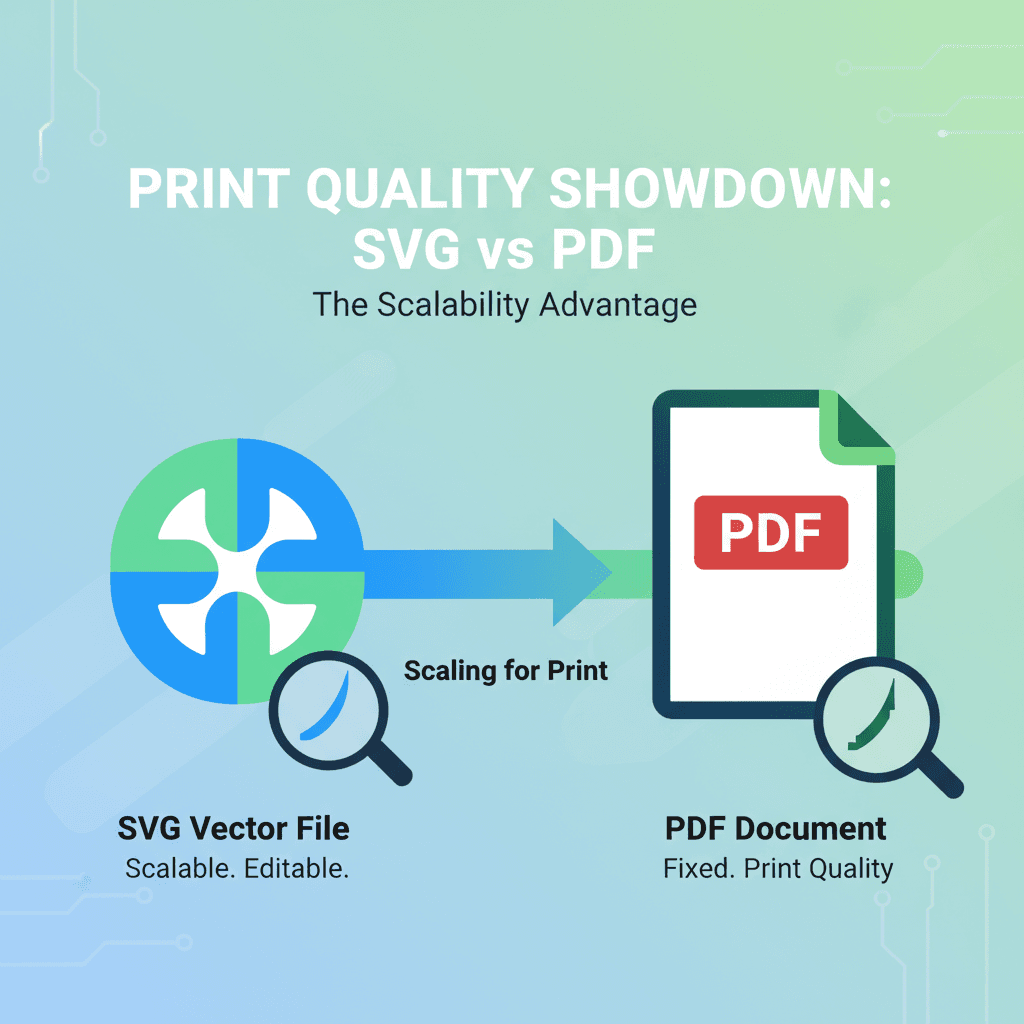
The best approach for most designers is to keep SVG as your master format and export to PDF when print requires it. Here is why:
- Create or convert your design to SVG using VectoSolve
- Edit and finalize in your vector tool (Illustrator, Figma, Inkscape)
- Export SVG for digital use — web, apps, cutting machines
- Export PDF/X for print — with CMYK conversion, bleed, and crop marks
This way you have one source file that serves every output need.
How VectoSolve Fits In
If you are starting from a raster image (photo, screenshot, scan), the first step is always vectorization. VectoSolve converts images to SVG in seconds — giving you a clean vector master file that you can then export to PDF, PNG, or any other format your workflow requires.
For print-on-demand sellers, the workflow is: image → VectoSolve (SVG) → export high-res PNG or PDF → upload to platform.
Frequently Asked Questions
Can I send an SVG file directly to a print shop?
Some print shops accept SVG, but most prefer PDF — specifically PDF/X format. Convert your SVG to PDF with CMYK colors and proper bleed settings before submitting to a professional printer.
Is SVG or PDF better for logos?
Keep your logo as SVG for digital use and web, and export as PDF for print materials. The SVG is your editable master file; the PDF is your print-ready deliverable.
Do Cricut machines accept PDF files?
Cricut Design Space does not support PDF directly. You need SVG or PNG files for Cricut. VectoSolve outputs clean, cut-ready SVG files that work perfectly with Cricut and Silhouette machines.
Which format has better color accuracy for print?
PDF wins for print color accuracy because it supports CMYK color profiles and ICC color management. SVG only supports RGB colors, which must be converted to CMYK for professional print — and that conversion can shift colors if not done carefully.
The Bottom Line
SVG for digital, PDF for print — that is the simple rule. Start with SVG as your scalable master format, then export to PDF when a printer requires it. And if you are starting from a raster image, vectorize it first with VectoSolve to get a clean SVG foundation.