AI Image Vectorization: Top Trends Shaping 2026
Discover the cutting-edge AI technologies transforming how we convert raster images to vectors. From neural networks to real-time processing, here is what is hot in 2026.

Graphics & Design Experts
Our team of experienced designers and developers specializes in vector graphics, image conversion, and digital design optimization. With over 10 years of combined experience in graphic design and web development.
Key Takeaways
- Real-time AI vectorization now processes images in under 1 second — a 60x speedup over traditional tracing
- Multimodal LLMs like Gemini enable semantic SVG generation directly from text prompts and mixed inputs
- Edge inference brings AI vectorization to browsers and mobile devices without cloud round-trips
- The AI vectorization market is projected to surpass $2.4 billion by 2028 at 34% CAGR
- 3D-to-SVG pipelines and neural style transfer are redefining what vector output looks like
- Batch AI processing handles 10,000+ assets per hour for enterprise design systems
The New Era of AI-Powered Vectorization
The vectorization landscape has undergone a seismic shift. What began as threshold-based tracing has evolved into a discipline driven by diffusion models, vision transformers, and multimodal AI. In 2026, the gap between raster and vector is no longer a conversion problem — it is an intelligence problem.
This article unpacks the trends shaping AI vectorization, grounds each in real technical progress, and forecasts where the field is heading. Whether you design at scale or need a clean SVG from a napkin sketch, these shifts will change how you work.
---
1. Real-Time Vectorization at Sub-Second Latency
Traditional autotracing tools took 30-60 seconds per complex image; manual Illustrator tracing consumed hours. The 2024-2026 generation of AI vectorizers — built on lightweight U-Net architectures and optimized ONNX runtimes — has collapsed that to under one second.
Designers now see live SVG previews as they tweak parameters. E-commerce platforms regenerate product vectors on the fly. Tools like VectoSolve offer instant conversion with zero queue time, even at high concurrency.
Potrace (CPU, 2020):         38 seconds
AI tracer v1 (GPU, 2022):   12 seconds
AI tracer v2 (GPU, 2024):    2.8 seconds
VectoSolve engine (2026):    0.7 seconds
Real-time isn't a luxury anymore — it is table stakes.
---
2. Multimodal LLMs and the Gemini Effect
The most disruptive force in vectorization today is the rise of multimodal large language models. Google's Gemini family can accept images, text, and video simultaneously, enabling three breakthroughs:
> "The most powerful vector tool in 2026 isn't a better tracing algorithm — it's an AI that understands what the image means, what the designer intends, and what the output needs to do." — Tobias van Schneider, design systems lead
---
3. Edge Inference: Vectorization Without the Cloud
AI vectorization was tethered to GPU-heavy cloud infrastructure. That constraint is dissolving. Model quantization (INT4, GPTQ), Apple's Core ML, and Google's MediaPipe now allow capable vectorization models to run directly in the browser or on-device.
Key enablers: WebGPU and WebNN APIs in Chrome/Edge for browser GPU access; ONNX Runtime for Web achieving near-native speed for sub-100M parameter models; and Apple Neural Engine on M-series chips for desktop apps.
For privacy-sensitive industries, edge vectorization eliminates data-in-transit concerns. For everyone else, it means zero-latency conversion with no API dependency.
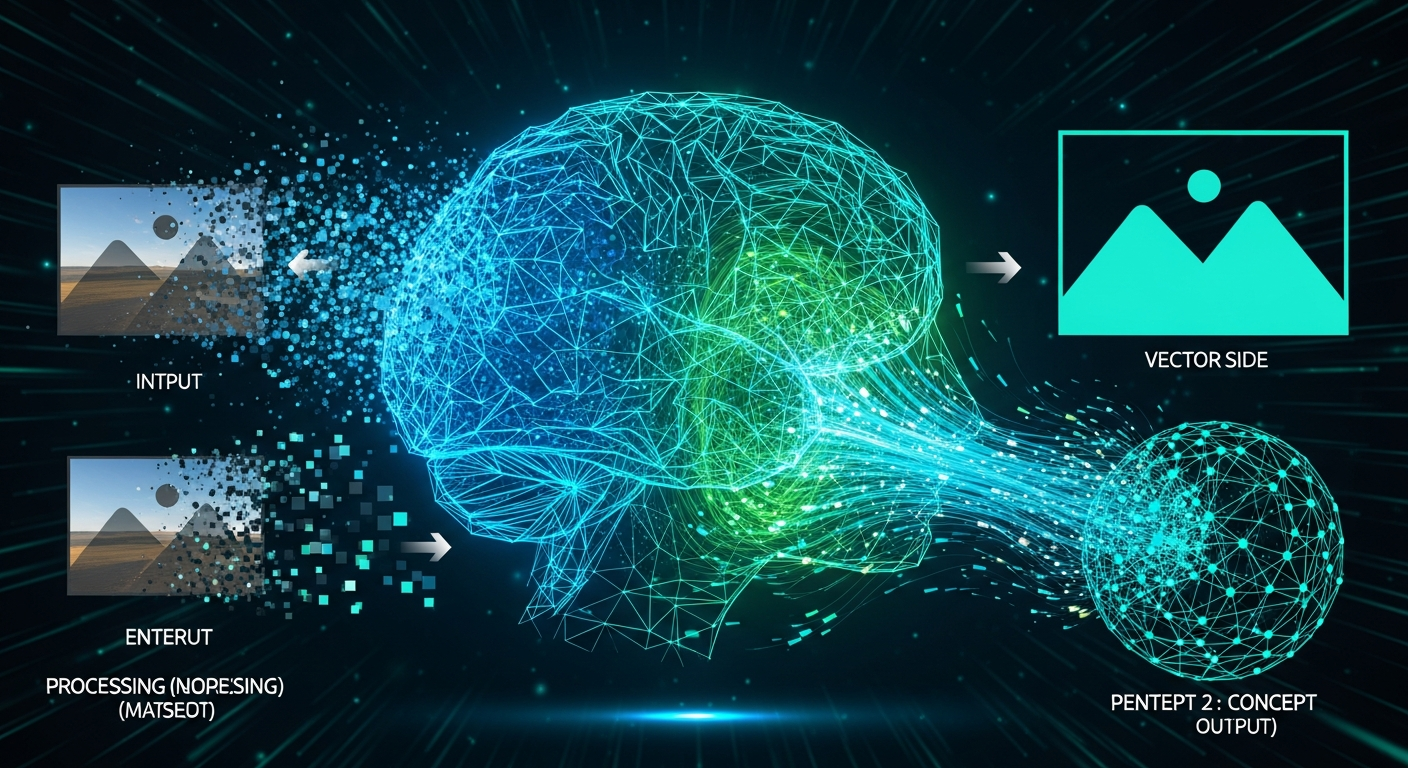
!How AI image-to-vector conversion works

---
4. Neural Style Transfer Meets Vector Output
Style transfer has existed in the raster world since 2015, but applying artistic styles during vectorization is a 2025-2026 breakthrough. New architectures combine a content encoder (structural geometry) with a style decoder (aesthetic characteristics on SVG output).
The VectoSolve AI Animate tool extends this by enabling animated style transitions within SVG — motion design workflows previously exclusive to After Effects.
---
5. 3D-to-SVG Pipelines
Rather than flattening 3D models to raster then tracing, new pipelines extract vector contours directly from mesh geometry. Use cases include isometric icon systems from 3D models, technical documentation with exploded-view diagrams from CAD files, and game UI assets as resolution-independent SVG.
NVIDIA's 2025 "DiffVec3D" paper showed diffusion-guided contour extraction from NeRFs producing SVGs with 40% fewer control points than silhouette algorithms — smaller files and smoother curves simultaneously.
---
6. Semantic Understanding and Structured SVG
Modern AI vectorizers are scene understanding engines. They recognize that pixels represent a face, logo mark, button, or product — and structure SVG accordingly: automatic id and class naming, layer grouping mirroring a designer's mental model, accessibility attributes for recognized elements, and animation-ready structure with isolated moving parts.
Traditional autotracing (Potrace, Illustrator Image Trace) converts images to limited color, finds contiguous regions, and fits Bezier curves to boundaries. It has no concept of what is in the image.
AI vectorization adds a perception layer. Vision transformers or diffusion models first understand the image — identifying objects, depth, and semantic regions — then generate SVG primitives reflecting that understanding. The result: fewer paths, meaningful structure, and output that behaves like hand-crafted vector art.
---
7. Batch AI Processing for Enterprise Scale
Enterprise adoption signals maturity. Retail giants and SaaS platforms convert libraries of hundreds of thousands of images to SVG:
| Metric | 2022 | 2024 | 2026 | |--------|------|------|------| | Images/hour (single GPU) | 800 | 3,200 | 12,000+ | | Average SVG file size | 48 KB | 31 KB | 18 KB | | Manual QA rejection rate | 22% | 9% | 3.1% |
VectoSolve offers API-first batch pipelines: upload a ZIP, receive optimized SVGs with metadata, color tokens, and accessibility markup — ready for design systems.
---
Evolution Timeline
| Era | Capability | Key Technology | Output Quality | |-----|-----------|---------------|---------------| | 2020 | Basic autotracing with AI edge detection | CNNs for edge maps | Simple logos; heavy cleanup | | 2022 | Color-aware vectorization, limited grouping | U-Net + Potrace | Good for icons and flat art | | 2024 | Multi-object understanding, style-aware | Vision Transformers, early diffusion | Production-ready commercial use | | 2026 | Full semantic SVG, text-to-vector, 3D-to-SVG | Multimodal LLMs, DiffVec, WebGPU | Matches expert hand-crafted vectors |
!SVG trends and technology evolution through 2026
---
Market Size and Adoption
---
Predictions: 2027-2028
Conversational vector editing. You will talk to your SVG — "make the logo bolder, shift the accent color warmer, add a drop shadow" — and a multimodal AI executes the edit in real time.
Video-to-animated-SVG. Short clips become lightweight animated SVG sequences replacing GIFs and MP4s on the web.
Design-system-aware vectorization. AI ingests your tokens (colors, spacing, type) and ensures every vectorized asset conforms automatically.
Federated training on proprietary assets. Enterprises fine-tune models on brand assets without sending data externally.
The designers who thrive won't trace fastest — they'll direct AI most effectively. Invest in: (1) prompt engineering for visual AI, (2) understanding SVG structure to evaluate AI output, (3) building design systems AI can plug into, and (4) experimenting with VectoSolve and AI Animate to develop intuition for what's possible. The gap between AI-assisted and manual-only designers is widening fast.
---
Conclusion
AI vectorization in 2026 is about understanding visual intent and producing structured, semantic, animation-ready, accessible SVG — at speeds that seemed impossible three years ago. The convergence of multimodal LLMs, edge inference, style transfer, and batch processing has turned vectorization into a foundational layer of modern design infrastructure. The question is no longer whether to adopt AI vectorization, but how deeply to integrate it.
---
| Trend | 2024 Status | 2026 Projection | Impact |
|---|---|---|---|
| Real-time vectorization | 3-5 second processing | Sub-1-second inference | Enables live design workflows |
| Multimodal text-to-SVG | Experimental | Production-ready (Gemini, GPT) | Natural language vector creation |
| Edge/browser inference | Server-only | WebGPU-accelerated client-side | Zero-latency, offline capable |
| AI market size (image tools) | $2.1B | $4.2B projected by 2028 | Massive investment and competition |