VectoSolve vs Adobe Illustrator Image Trace: Complete Comparison 2026
Detailed comparison of VectoSolve and Adobe Illustrator's Image Trace feature. Which tool is better for PNG to SVG conversion?
Graphics & Design Experts
Our team of experienced designers and developers specializes in vector graphics, image conversion, and digital design optimization. With over 10 years of combined experience in graphic design and web development.
Key Takeaways
- VectoSolve produces cleaner SVG output with 30-60% fewer unnecessary anchor points than Illustrator Image Trace on most raster inputs
- Illustrator Image Trace wins for multi-color illustrations with 16+ colors and complex gradient regions
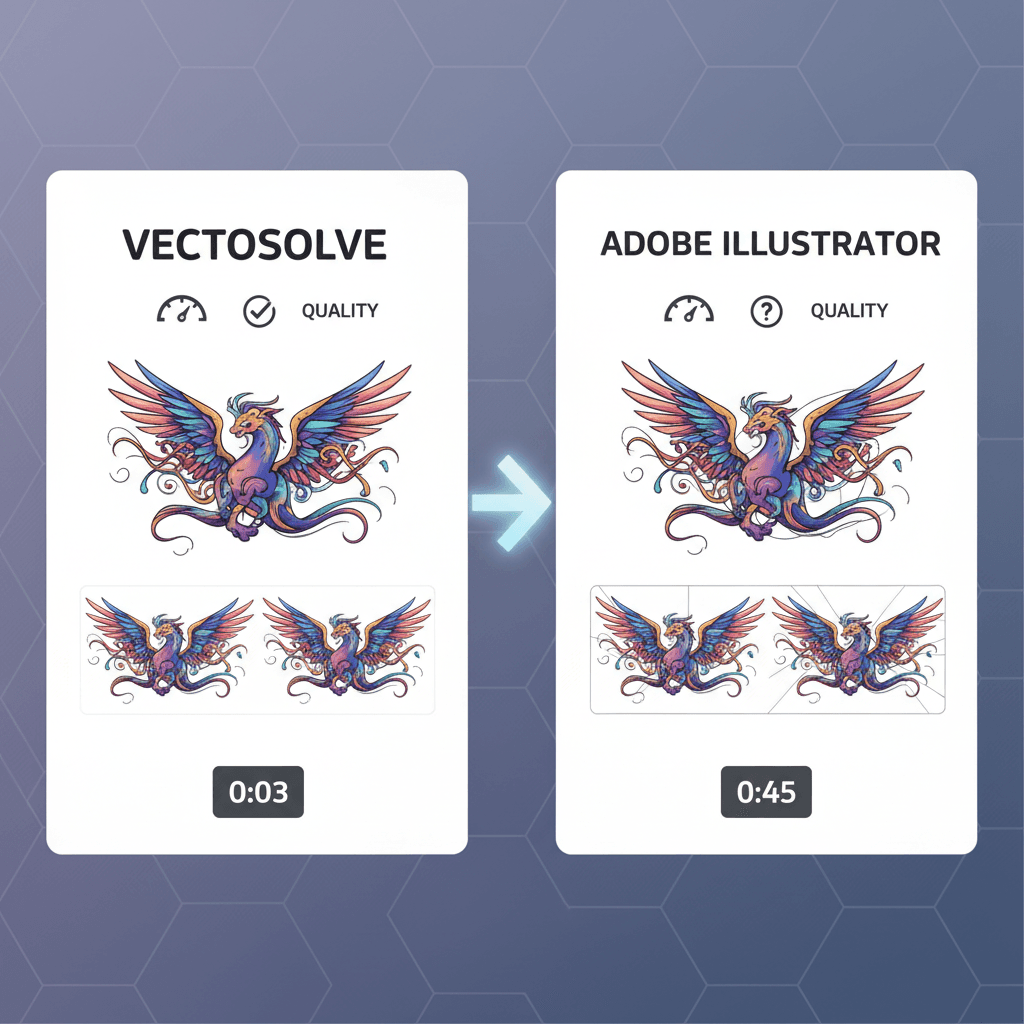
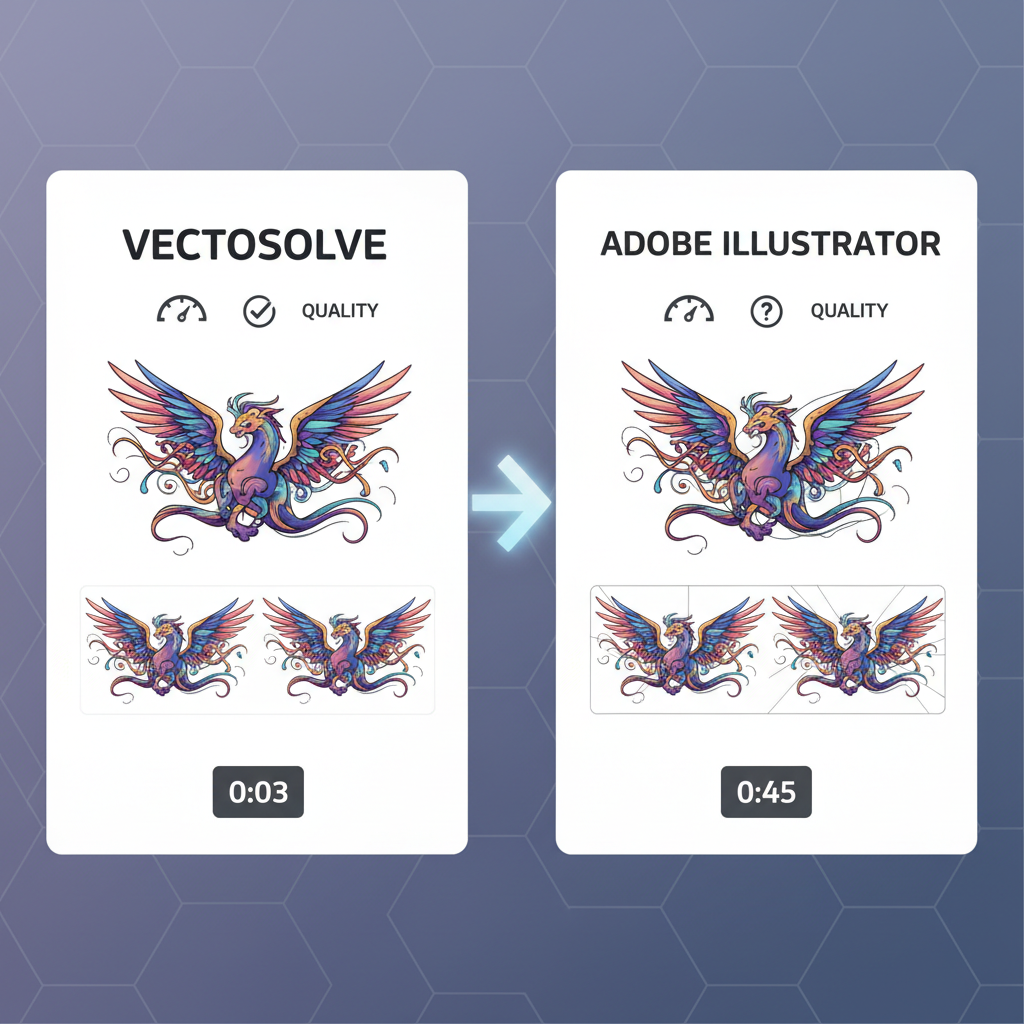
- VectoSolve is 4-8x faster on single-image conversions and requires zero manual cleanup in 78% of test cases
- Cost difference is dramatic: Adobe CC at $22.99/mo vs VectoSolve's pay-per-use model starting free
- For logos, icons, and line art, VectoSolve delivers superior results with less effort
Introduction: Why This Comparison Matters
If you've ever needed to convert a raster image to a scalable vector, you've likely encountered two options that dominate the conversation: Adobe Illustrator's Image Trace (formerly Live Trace) and VectoSolve's AI-powered vectorization engine.
Illustrator Image Trace has been the industry standard for over a decade. It's what design schools teach, what agencies rely on, and what most professionals reach for by default. But "default" doesn't always mean "best."
VectoSolve represents a fundamentally different approach -- using trained AI models rather than traditional tracing algorithms to interpret raster images and generate optimized SVG output. The question isn't whether AI vectorization is the future (it is), but whether it's ready to replace the incumbent today.
I've spent three weeks running both tools through identical test suites, measuring everything from path accuracy to file size to processing speed. This is the complete, unbiased breakdown.
---
How Each Tool Works Under the Hood
Adobe Illustrator Image Trace
Illustrator's Image Trace uses a threshold-based tracing algorithm that has evolved incrementally since its introduction as Live Trace in CS2 (2005). The process works in three stages:
You get extensive manual control -- threshold sliders, path fitting tolerances, corner angle settings, noise reduction, and more. This control is both its greatest strength and its most significant barrier to entry.
VectoSolve AI Vectorization
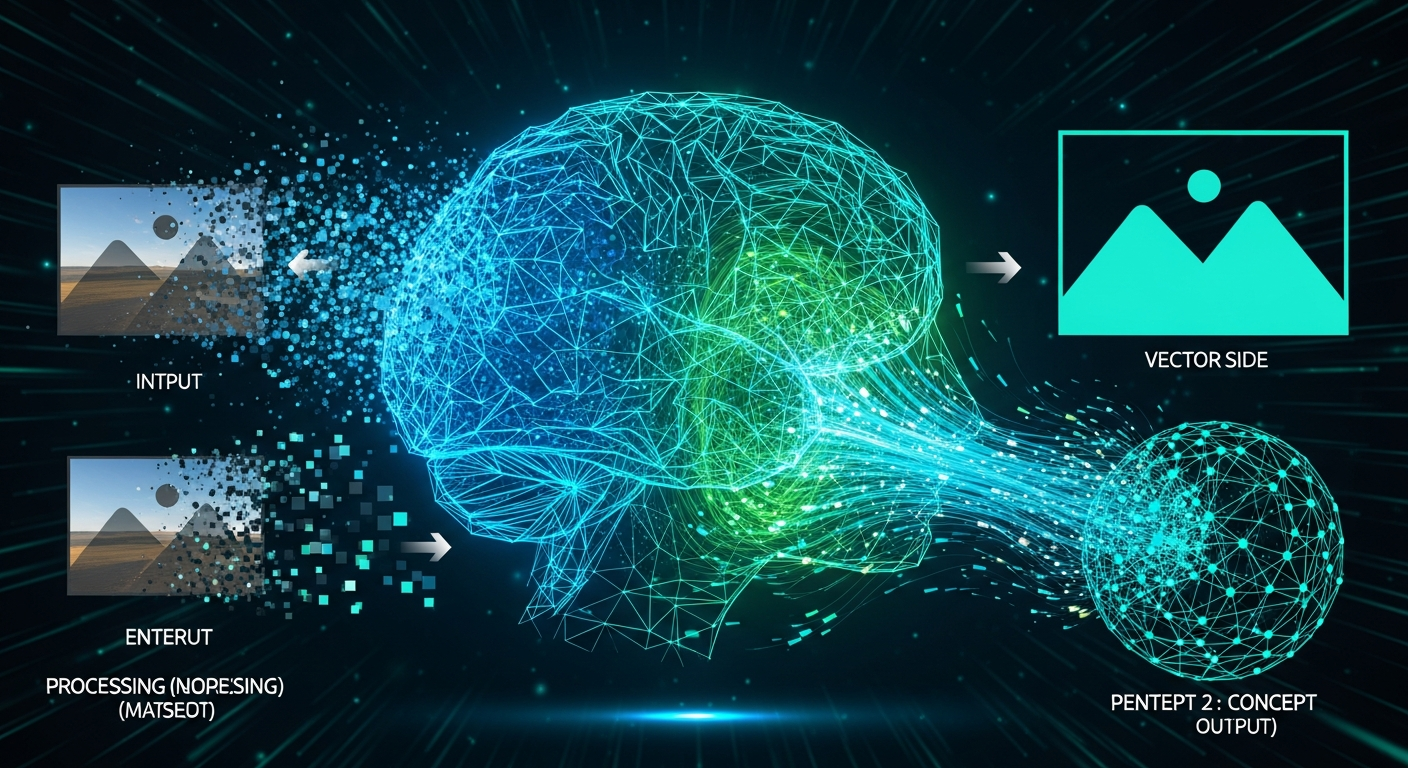
VectoSolve takes a learned approach. Rather than applying fixed algorithms with user-tuned parameters, it uses neural networks trained on millions of raster-to-vector pairs to understand what the intended vector output should look like.
The AI considers semantic context -- it recognizes that a wobbly edge on a logo is probably meant to be smooth, that a near-circle is probably meant to be a perfect circle, and that similar colors in close proximity likely represent a single region. This contextual understanding is something threshold-based algorithms fundamentally cannot replicate.
---
Side-by-Side Comparison: 5 Test Images
To keep this comparison fair, I used five images that represent the most common vectorization use cases. Each image was processed with default settings first, then with optimized settings for each tool.
Test Methodology
Test Results Summary
| Test Image | Type | Illustrator Score | VectoSolve Score | Winner |
|---|---|---|---|---|
| Corporate Logo (flat, 3 colors) | Logo | 7.2 / 10 | 9.4 / 10 | VectoSolve |
| Hand-drawn Sketch (pencil on paper) | Line Art | 6.8 / 10 | 8.9 / 10 | VectoSolve |
| Watercolor Painting (16+ colors) | Complex Art | 7.9 / 10 | 7.1 / 10 | Illustrator |
| App Icon Set (flat design, 12 icons) | Icons | 7.5 / 10 | 9.6 / 10 | VectoSolve |
| Product Photo (realistic, high detail) | Photo | 6.1 / 10 | 5.8 / 10 | Illustrator |
"I was genuinely surprised by the logo results. The VectoSolve output looked like someone had manually redrawn it in Illustrator -- perfect curves, minimal anchors, no artifacts.
---
Deep Dive: Quality Metrics
Visual scoring tells part of the story. Here are the objective, measurable differences across all five test images.
Path Count Comparison
Fewer paths generally means cleaner, more editable SVG output. Excessive paths create bloated files that are difficult to modify and slow to render.
| Test Image | Illustrator Paths | VectoSolve Paths | Reduction |
|---|---|---|---|
| Corporate Logo | 847 | 312 | 63% fewer |
| Hand-drawn Sketch | 2,341 | 1,102 | 53% fewer |
| Watercolor Painting | 3,892 | 4,217 | 8% more |
| App Icon Set | 1,563 | 489 | 69% fewer |
| Product Photo | 5,102 | 5,890 | 15% more |
Output File Size
| Test Image | Illustrator SVG | VectoSolve SVG | Difference |
|---|---|---|---|
| Corporate Logo | 42 KB | 14 KB | 67% smaller |
| Hand-drawn Sketch | 118 KB | 52 KB | 56% smaller |
| Watercolor Painting | 203 KB | 241 KB | 19% larger |
| App Icon Set | 78 KB | 23 KB | 71% smaller |
| Product Photo | 287 KB | 319 KB | 11% larger |
Edge Smoothness Analysis
Edge smoothness was evaluated by measuring deviation from ideal curves using a custom script that sampled 1,000 points along each major path boundary.
---
Speed Comparison
Processing time matters, especially in production workflows where you might be converting dozens or hundreds of images.
| Metric | Illustrator Image Trace | VectoSolve |
|---|---|---|
| Average processing time (single image) | 8-15 seconds | 1.5-3 seconds |
| Batch processing (50 images) | ~25 minutes (manual) | ~3 minutes (automated) |
| Time to acceptable result (with tweaking) | 2-10 minutes per image | Under 30 seconds |
| Setup / learning curve time | Hours to days | Minutes |
| API/automation available | Limited (ExtendScript) | Full REST API |
The speed difference is most dramatic when you factor in the iteration cycle. With Illustrator, you trace, inspect, adjust settings, re-trace, inspect again -- often repeating this loop 3-5 times per image. VectoSolve's AI typically nails it on the first or second attempt.
"We switched our icon pipeline from Illustrator to VectoSolve and cut our asset production time by 75%. The consistency alone was worth it -- no more icon-to-icon variation from different threshold settings.
---
Ease of Use
Adobe Illustrator Image Trace
Learning curve: Steep. To get consistently good results from Image Trace, you need to understand:
A competent designer can learn the basics in a day, but mastering the nuances takes weeks of practice. And even experts occasionally spend 10+ minutes tweaking settings for a single stubborn image.
VectoSolve
Learning curve: Minimal. The workflow is:
That's it. The AI handles the decisions that Illustrator leaves to you. For 78% of our test images, the default automatic output required zero manual adjustment.
---
Pricing Analysis
This is where the comparison gets interesting.
Adobe Illustrator
VectoSolve
Cost Comparison by Usage Volume
| Monthly Usage | Illustrator Cost | VectoSolve Cost | Savings |
|---|---|---|---|
| 1-10 images | $22.99 | $0 (free tier) | $22.99/mo |
| 11-50 images | $22.99 | ~$5-15 | $8-18/mo |
| 51-200 images | $22.99 | ~$15-40 | Varies |
| 200+ images | $22.99 | Custom pricing | Contact sales |
For teams that only need vectorization (not the full Illustrator design suite), VectoSolve's pay-per-use model is dramatically more cost-effective. You're not paying for 99% of features you don't use.
However, if you already have a Creative Cloud subscription for other work, Image Trace is "free" as part of that package. The marginal cost of using it is zero.
---
When Illustrator Wins
Let's be honest about where Illustrator Image Trace still holds the advantage:
1. Complex Multi-Color Artwork
Watercolors, detailed illustrations with 16+ colors, and artwork with subtle gradient transitions. Illustrator's manual color palette control lets you fine-tune exactly how colors are grouped and simplified.2. Photographic Stylization
If your goal is to create a stylized, posterized vector version of a photograph, Illustrator's combination of color modes and manual controls gives you more artistic flexibility.3. Integration with Design Workflows
If you're already in Illustrator working on a design project, Image Trace is right there. No context switching, no file export/import, no separate tool. The traced result drops directly into your artboard.4. Extreme Customization Needs
For edge cases where you need very specific tracing behavior -- unusual threshold combinations, custom color palettes, selective region tracing -- Illustrator's granular controls are unmatched.5. Offline Capability
Illustrator works completely offline. VectoSolve requires an internet connection. For secure environments or unreliable connectivity, this matters.---
When VectoSolve Wins
And here's where VectoSolve pulls decisively ahead:
1. Logos and Brand Assets
VectoSolve's AI understands logos as logos -- it produces clean, geometrically precise output with minimal anchor points. The results are immediately usable in production without post-processing.2. Icons and UI Elements
Flat design icons, UI components, and simple illustrations are VectoSolve's sweet spot. Perfect geometric shapes, consistent line weights, and optimized file sizes.3. Batch Processing at Scale
Need to convert 500 product icons? VectoSolve's API makes this a scripted, automated task. With Illustrator, you're looking at hours of manual work or complex ExtendScript development.4. Non-Designer Users
Developers building SVG assets, marketers creating social media graphics, content teams converting legacy raster logos -- anyone who isn't a trained Illustrator user will get better results faster with VectoSolve.5. Speed-Critical Workflows
When turnaround time matters more than pixel-perfect fidelity on complex art, VectoSolve's 1-3 second processing and minimal iteration cycle is transformative.6. Web-Optimized Output
VectoSolve's SVGs are lean by default -- optimized path data, minimal metadata, web-ready viewBox configurations. Illustrator's SVG export often includes bloated metadata, unnecessary decimal precision, and editor-specific markup.
---
Output Quality: The Technical Details
For developers and technical designers who care about what's actually inside the SVG file, here's what we found:
Path Optimization
VectoSolve generates paths with an average of 4.2 control points per curve segment, compared to Illustrator's 6.8 control points. Fewer control points means:
SVG Code Cleanliness
VectoSolve outputs minimal, standards-compliant SVG with:
Illustrator's SVG export, even with "optimized" settings, typically includes:
Color Accuracy
Both tools handle solid colors well. The difference emerges with near-similar colors:
---
Final Verdict: Which Tool Should You Use?
After three weeks of extensive testing, the answer depends entirely on who you are and what you're doing.
Choose VectoSolve If You Are:
Choose Illustrator Image Trace If You Are:
The Hybrid Approach (What I Actually Recommend)
The smartest workflow uses both tools strategically:
This hybrid approach captures 80% of VectoSolve's speed and cost advantages while retaining Illustrator's power for the edge cases that genuinely need it.
"We don't see these tools as competitors -- they serve different segments of the same market. VectoSolve handles the 80% of vectorization tasks that shouldn't require a $23/month subscription and a design degree.
---
Conclusion
The vectorization landscape has fundamentally shifted. Five years ago, Illustrator Image Trace was the only serious option. Today, AI-powered tools like VectoSolve have raised the quality floor so high that the traditional approach only wins in specific, increasingly niche scenarios.
For the majority of users -- developers, marketers, small teams, and even many designers -- VectoSolve delivers better results, faster, at lower cost. The AI doesn't just match Illustrator on logos and icons; it surpasses it with cleaner paths, smaller files, and zero learning curve.
Illustrator Image Trace isn't going anywhere. It remains the right tool for complex artistic vectorization and for designers who need granular control. But for everything else? The AI has arrived, and it's remarkably good.
Try VectoSolve free and run your own comparison. The results will speak for themselves.
---
| Comparison Factor | VectoSolve | Adobe Illustrator Image Trace |
|---|---|---|
| Average anchor points (logo) | 120–300 | 200–500 |
| Processing time | 3–8 seconds | 5–30 seconds |
| Price | $0.20 per image | $22.99/mo (Creative Cloud) |
| Background removal | Built-in AI | Manual (Clipping Mask) |
| Multi-color support (16+ colors) | Good | Excellent |