
DTF Gang Sheet Sizes: The Complete Chart and the Capacity Math
Standard DTF gang sheet sizes (22×12" to 22×120"), an honest capacity table for common design sizes, the file rules that prevent misprints, and why fill rate decides your real cost per design.
Founder of VectoSolve
Self-taught developer, founder and sole developer of VectoSolve since 2024. He builds the conversion engine and the cutting, embroidery and 3D printing exports.
How this article was made: drafted with AI assistance, then edited and fact-checked before publication. About the author
Try it on your own file, in DTF mode
Free preview, no signup. Drop an image and see the vector before deciding anything.
What a Gang Sheet Is (and Why the Math Matters)
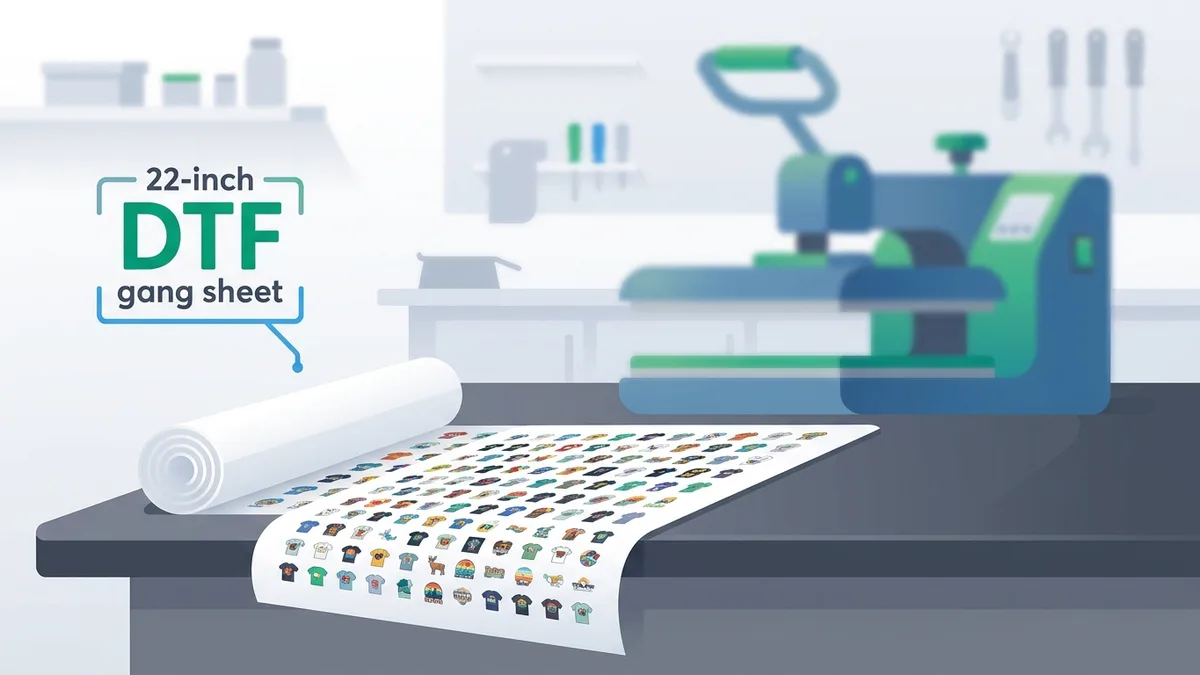
A DTF gang sheet is one large transfer film carrying many designs at once. Printers charge by the sheet or by the linear foot, not by the design — so every square inch you leave empty is money you already spent. Two shops can order the same 22×60" sheet: one fits 40 designs on it, the other fits 55. Same price, 37% more product.
And the pot is growing: the global direct-to-film printing market was estimated at USD 2.85 billion in 2025 and is projected to reach USD 4.46 billion by 2032 at a 6.57% CAGR, according to 360iResearch. More sellers gang-printing onto the same blanks means layout efficiency is one of the few durable edges left.
That difference is pure layout. This page gives you the standard sizes, the real capacity math, and the file rules that keep a sheet from printing wrong.
Standard DTF Gang Sheet Sizes
Almost the entire industry has settled on a 22-inch print width (about 56 cm — it comes from the dominant film roll width, with a small margin for pinch rollers). Length is what you choose:
| Sheet | Inches | Centimeters | Printable area |
|---|---|---|---|
| Small | 22 × 12 | 56 × 30.5 | 264 in² |
| Medium | 22 × 24 | 56 × 61 | 528 in² |
| Large | 22 × 60 | 56 × 152 | 1,320 in² |
| XL roll | 22 × 120 | 56 × 305 | 2,640 in² |
Those rows track what the big vendors actually sell. Ninja Transfers' Build Your Own Gang Sheet tool offers exactly six sizes, every one of them 22 inches wide — 22×24, 22×60, 22×84, 22×120, 22×180, and 22×240, i.e. two feet to twenty feet — in Standard and Glitter film styles (ScreenPrinting.com, checked July 2026). Teddy Transfers sells the same fixed 22-inch width but prices length by the inch: 5 to 150 inches, in 5-inch steps on the order menu. Transfer Express is the fixed-sheet exception — its UltraColor Max DTF gang sheets come in just two formats, a small 12"×22" and a large 24"×22". And DTG PRO runs a 23-inch printable width, in six areas from 23"×2 ft up to 23"×50 ft, because its film stock is 24 inches wide and the last inch is reserved to keep art away from edge cutoff.
Some providers sell odd lengths (22×36", 22×48", or "by the foot"), but 12/24/60/120 covers most menus. Per square inch, longer sheets are almost always cheaper — the press time is where the margin lives. Teddy Transfers makes that explicit on its price list: sheets under 24 inches carry a setup cost at a higher per-inch price, while orders of 24 inches and up get a flat, lower per-inch rate — so if your layout lands at 15 inches, filling it out to 24 usually costs very little more.
Where the 22-inch width comes from
The width is set upstream by the film roll, not by the gang sheet vendor. DTF Station, one of the main film manufacturers, sells its roll film in ten widths — 20, 30, 33, 35, 40, 45, 60, 76, 80, and 90 cm — with 100 meters as the standard length for every width. The 60 cm roll is the wide-format workhorse: 60 cm × 100 m works out to 23.6 inches wide by 328 feet long, sold for DTF printers that feed film from a roll (DOMAGRON). Take that 23.6-inch film, subtract the margin the pinch rollers and edge tolerance need, and you get the 22 inches of dependable printable width the gang sheet market is built on — or 23 inches at vendors like DTG PRO that run the margin tighter.
How Many Designs Fit: The Honest Capacity Table
Capacity depends on design size and spacing. The table below assumes square designs, a 0.5" gap between designs (the common safe minimum for cutting them apart), and simple row-based packing — the same logic most gang sheet builders use:
| Design size | 22×12" | 22×24" | 22×60" | 22×120" |
|---|---|---|---|---|
| 3.5" (left chest) | 15 | 30 | 75 | 150 |
| 4.5" (youth front) | 8 | 16 | 48 | 96 |
| 10" (adult front) | 2 | 4 | 10 | 22 |
| 11.5" (full back) | 1 | 2 | 5 | 10 |
Three things the table teaches:
- Small designs are absurdly efficient. A 22×60" sheet holds 75 left-chest logos. If you sell name-drop or pocket designs, gang them — never print them solo.
- Big designs waste edges. One 11.5" back print on a 12" sheet leaves a 10-inch strip you paid for. Mix sizes: tuck sleeve prints and pocket hits into the gaps around large designs.
- Mixed layouts beat uniform ones. Real orders are never all one size. An auto-nesting layout that slots a 3.5" design into the dead corner next to a 10" one recovers area a by-hand grid loses. (Our free gang sheet builder does this packing automatically and exports the print-ready file.)
A Full Year of Conversions for $49
Starter Annual: 25 conversions every month, $49 for the whole year. That is about $4.08 a month · Cancel anytime
Get the Annual DealFile Rules That Keep Your Sheet From Printing Wrong
DTF is forgiving on fabric and brutal on files. The rules:
300 DPI at print size. A 10-inch design needs to be 3,000 pixels wide. Upscaling a small web image in software does not create detail — if the source is small, run it through an AI upscaler first or convert it to vector and re-export at any size.
Transparent PNG, and truly transparent. JPG has no alpha channel — a JPG on a gang sheet prints as a design inside a white rectangle. Remove the background properly (one-click background removal) and check the checkerboard.
No semi-transparent pixels. The white ink underbase follows your alpha channel. A soft drop shadow at 40% opacity prints as a milky white haze around the design. Use hard edges, or flatten shadows to solid shapes intentionally.
Respect minimum sizes. Fine lines under about 1.5 pt and text under roughly 2.5–3 mm tall tend to fill in or crack after pressing. If the design comes from a photo or a busy logo, vectorizing it first with a limited color count gives you clean, printable shapes.
Leave the mirroring to the RIP. DTF film is printed reversed and flipped onto the garment, but the print shop's RIP software mirrors automatically in almost every workflow. Upload right-reading art unless your provider's spec sheet explicitly says otherwise — pre-mirrored files get double-flipped.
Keep the 0.5" gap. Designs that touch can lift each other's edges when the transfers are cut apart. Half an inch is the standard safe spacing; some shops accept 0.3" if they cut by machine.
The Cost Logic: Fill Rate Is Everything
Gang sheet pricing is per sheet, so your real cost per design is:
sheet price ÷ number of designs that actually fit
What "a typical market price" means, checked against live vendor pages in July 2026: advertised gang sheet pricing runs from roughly $0.02 to $0.04 per square inch. DTG PRO anchors the low end at $2.99 per square foot — about $0.021 per square inch — though that floor applies to the largest sheets; its smallest 4 sq ft sheet was listed at a sale price working out to roughly $6.75 per square foot. Teddy Transfers advertises from $0.025 per square inch. Transfer Express sits at the top of the range, at "as low as $0.04 per square inch" on gang sheets, with quantity price breaks at 1, 10, and 25+ sheets. For per-sheet dollar figures, Vinyl Craft Studio listed a 22×24 at $13.00 and a 22×60 at $29.95 — about $0.025 and $0.023 per square inch respectively (both listings were marked sold out at the time of check).
Put real dollars on the fill-rate math: at that $29.95 for a 22×60" sheet, the 48 youth-front designs a tight layout holds cost $0.62 each — while a loose layout with big margins fits 30 and pays $1.00 each. That's a 60% difference in unit cost for identical printing. Before you order, spend two minutes tightening the layout; it is the highest-paid two minutes in DTF.
The workflow that gets the best fill rates:
- Prep each design: remove the background, check resolution, upscale or vectorize if needed.
- Load everything into the gang sheet builder with real print widths and quantities.
- Let the auto-nesting pack the sheet, check the preview, and export the 300 DPI transparent PNG.
- Send that one file to your printer.
FAQ
Can I mix dark-shirt and light-shirt designs on one sheet?
Yes — DTF transfers work on any fabric color because of the white underbase, so a gang sheet doesn't care what garments the designs end up on. That's a real advantage over screen print separations.
What format does the print shop want?
A flattened, transparent PNG at 300 DPI sized exactly to the sheet dimensions is the universal answer. A few shops accept PDFs or TIFFs; nobody wants a layered working file.
Is there a free tool that does the layout?
Yes — our gang sheet builder is free, runs entirely in your browser (files never upload), auto-packs your designs onto standard 22" sheets, and exports the print-ready PNG. No account needed.
Free SVG Tools for Crafters
Design Checker · Color Separator · Mat Preview · Offset Generator · Text to SVG
Check Your SVG FreeSources
- ScreenPrinting.com (Ninja Transfers DTF Gang Sheet Builder) — the six standard gang sheet sizes, all 22" wide (22×24 through 22×240), in Standard and Glitter film styles.
- Teddy Transfers gang sheet page — fixed 22" width with 5–150" lengths in 5" steps, pricing from $0.025/sq in, and the setup cost on sheets under 24".
- Transfer Express gang sheets page — 12"×22" and 24"×22" fixed sheets at as low as $0.04/sq in, with quantity breaks at 1, 10, and 25+ sheets.
- DTG PRO gang sheet product page — 23"-wide sheets from 2 to 50 ft at from $2.99/sq ft, and the 24" film / 23" printable-width cap.
- Vinyl Craft Studio 22×60 listing and 22×24 listing — the $29.95 and $13.00 per-sheet prices used in the cost-per-design math.
- DTF Station film roll page — film roll widths from 20 to 90 cm with 100 m as the standard roll length for all widths.
- DOMAGRON DTF film roll page — the 60 cm × 100 m roll spec (23.6" × 328 ft) for roll-feeding DTF printers.
- 360iResearch — Direct to Film Printing Market — market size estimates: USD 2.85 billion (2025) to USD 4.46 billion (2032) at a 6.57% CAGR.
VectoSolve — AI-powered SVG platform: image-to-vector conversion, AI animation, brand identity generation, and more. https://vectosolve.com