DTF vs Screen Printing: The Real Cost Math (2026)
Screen printing charges per color before the first shirt; DTF charges per square inch forever. The break-even table, where each method punishes you, and the hybrid setup most shops land on.
Founder of VectoSolve
Self-taught developer, founder and sole developer of VectoSolve since 2024. He builds the conversion engine and the cutting, embroidery and 3D printing exports.
How this article was made: drafted with AI assistance, then edited and fact-checked before publication. About the author
Try it on your own file, in Screen Print mode
Free preview, no signup. Drop an image and see the vector before deciding anything.
The Only Question That Matters: How Many Pieces?
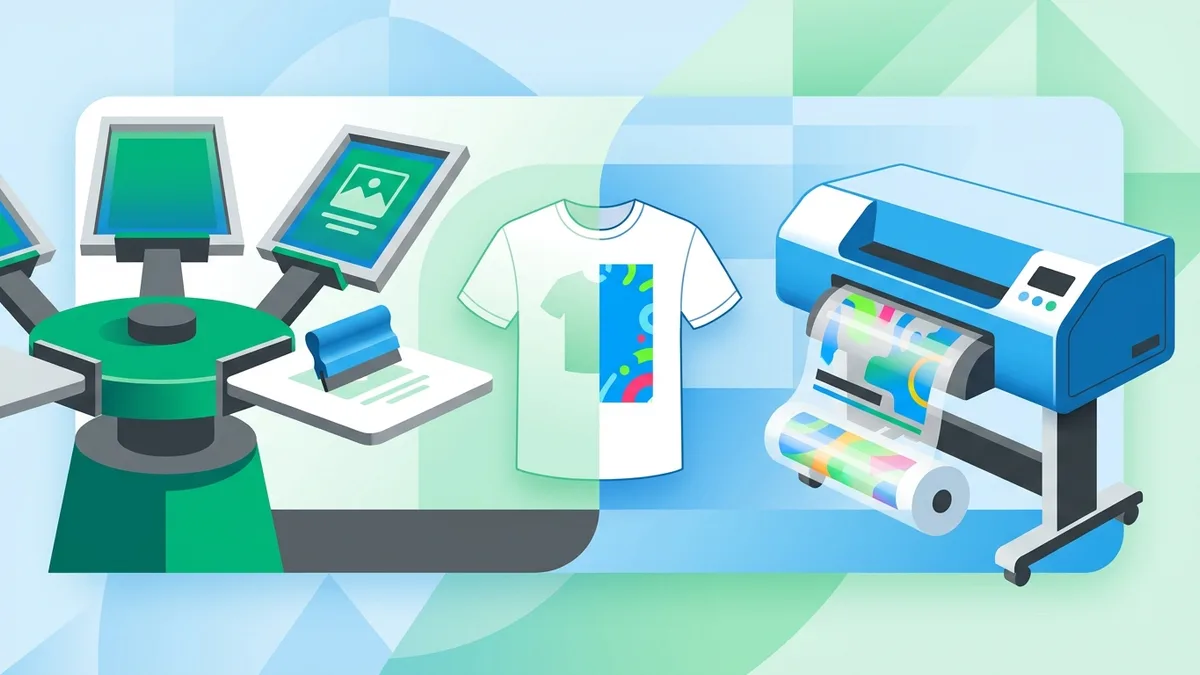
DTF and screen printing don't compete on quality anymore — a well-pressed DTF transfer and a well-cured screen print both survive 50+ washes when done right. They compete on cost structure, and the structures are opposites:
- Screen printing has a fixed setup cost per color (a screen must be coated, burned, registered and cleaned) and a tiny marginal cost per print. Expensive to start, nearly free to continue.
- DTF has zero setup and a flat cost per square inch of film. The 1st shirt and the 500th shirt cost exactly the same.
Everything below follows from that.
Neither method is going away, which is why the cost-structure question keeps coming up. Grand View Research values the global direct-to-film printing market at USD 2.72 billion in 2024, projected to reach USD 3.92 billion by 2030 at a 6.0% CAGR (April 2025 report). KBV Research independently sizes the same market at USD 2.68 billion in 2024, reaching USD 4.15 billion by 2032 at a 5.8% CAGR. Two named firms landing within roughly $40 million of each other on the 2024 figure is about as reliable as market sizing gets: DTF is a ~$2.7 billion market growing near 6% a year, not a fad screen printers can wait out.
The Break-Even Logic
(Want the answer for your exact job? Run your design size, colors and quantity through our free print cost calculator — every assumption is editable.)
Say a design has 4 colors. In screen printing that's 4 screens to burn — a real labor and materials cost before shirt one, typically tens of dollars of shop time per screen. Live shop pricing bears this out. Hemlock Ink charges a one-time $15 per screen, with one screen per color per print location — their own worked example prices a 2-color front plus 1-color back job at $45 in setup before the first shirt prints (Hemlock Ink pricing page). At the upper end, Raygun Printing in Brooklyn charges $30 per spot color for the screen plus $15 per color for film positives, according to its published price guide. In DTF it's zero: color count doesn't change the film price at all.
So the decision runs on run size:
| Run size | 1-2 colors | 4+ colors | Photorealistic / gradients |
|---|---|---|---|
| 1–24 pieces | DTF | DTF | DTF |
| 25–100 pieces | Either — quote both | DTF usually wins | DTF |
| 100–500 pieces | Screen print | Either | DTF or sim-process |
| 500+ pieces | Screen print | Screen print | Specialist sim-process |
The general shape: DTF owns small runs and high color counts; screen printing owns volume and simplicity. The crossover moves with your shop's setup cost — if you already have screens burned for a repeat client, screen printing wins much earlier. Shops price for exactly this: Hemlock Ink waives screen fees entirely on reorders placed within a year, and Raygun stores screens for up to 3 months and charges a reduced $15 per screen on reorders inside that window. A repeat client's second run carries little or no setup at all.
The Hardware Outlay Is Closer Than You'd Think
The consumable economics differ wildly, but the entry hardware sits in the same bracket. An entry-level desktop DTF setup — the DTF Station Prestige A4 bundled with a film roll, CMYKW ink, adhesive powder, cleaning supplies and a RIP software trial — is listed at $1,995 on sale ($2,995 regular) at All American Print Supply (promo price captured July 15, 2026; subject to change). A mid-range manual screen press — the Riley Hopkins 250+ 4-color, 4-station with XY micro registration — lists at $2,699.96 on sale ($2,999.95 regular) at ScreenPrinting.com, and that's the press only: screens, exposure unit, inks and a dryer are all extra (also a sale price captured July 15, 2026).
So the real difference isn't the machine — it's what happens per job after you own it. The screen press keeps charging you setup labor per color per design; the DTF printer keeps charging you ink and film per square inch. Which one bleeds you depends entirely on your order mix, which is the point of the break-even table above.
A Full Year of Conversions for $49
Starter Annual: 25 conversions every month, $49 for the whole year. That is about $4.08 a month · Cancel anytime
Get the Annual DealWhere Each Method Punishes You
Screen printing punishes color count. Every color is a screen: setup, registration, cleanup. This is why converters that cap colors matter — vectorizing customer art with a hard color limit turns a 14-color JPG into a 3-screen job the customer can actually afford. At Raygun Printing's published rates ($30 screen + $15 film per color), that's the difference between $630 and $135 in setup before the first shirt.
DTF punishes wasted film. You pay per sheet, so unit cost is sheet price divided by how many designs you actually fit. A loosely packed 22×60" sheet can cost 40-60% more per design than a tight one. Gang your designs properly — it's the entire margin on small orders.
Both punish bad source files. Raster logos at 72 DPI, backgrounds that were never removed, semi-transparent shadows — every one of those becomes either artist time (screen print) or a ruined transfer (DTF). Prep is the shared step: remove the background, vectorize for screens or upscale to 300 DPI for film.
Hand Feel, Fabrics, and the Details Shops Argue About
- Hand feel: a properly done screen print (especially water-based or discharge ink) sits softer than DTF's film layer. DTF has improved, but on large solid areas the film is noticeable. For fashion brands where hand matters, this alone can decide.
- Fabric range: DTF wins outright — cotton, poly, blends, nylon, denim, dark or light, no separate underbase decision. Screen printing on polyester needs bleed-blocking inks; on darks it needs an underbase (one more screen).
- Durability: screen print has the edge on stretch recovery and very long wash life; quality DTF is close behind and beats cheap screen printing every time. The published numbers support this, with the caveat that they come from manufacturers: Ninja Transfers states a DTF print can typically last 50 to 100 washes with regular use and standard washing and drying (a manufacturer claim with no published test protocol), and Supacolor publishes an Intertek Testing Services machine wash test in which no cracking or color fading appeared on its transfers until the 70th wash cycle, when only minimal cracking began. Conditions matter — wash cold, inside out, and skip the high-heat dryer to land at the top of those ranges.
- Detail: DTF resolves fine detail and gradients natively (it's an inkjet print). Screen printing needs halftones for tones — which is its own craft: our halftone generator turns tones into printable dot patterns for single-screen jobs.
The Hybrid Answer Most Shops Land On
Real shops don't pick one. The pattern that keeps margins healthy:
- Quote small and multicolor jobs as DTF — no setup, gang multiple orders onto shared sheets (sizes and capacity math here).
- Quote volume repeats as screen print — burn the screens once, amortize across reorders.
- Standardize art prep so either path starts from clean files: background removed, vectorized with a sane color count, correct size at 300 DPI.
That third step is where most quoting time dies — customer art arrives as screenshots and phone photos. Automating the first pass (image to vector in ~10 seconds, free preview) is how small shops quote fast without an art department.
Free SVG Tools for Crafters
Design Checker · Color Separator · Mat Preview · Offset Generator · Text to SVG
Check Your SVG FreeFAQ
Is DTF cheaper than screen printing?
For runs under ~25 pieces or designs with 4+ colors: almost always. For 500 one-color shirts: almost never. Between those, quote both — your setup costs decide.
Can I convert the same design for both methods?
Yes, but they want different files: DTF wants a 300 DPI transparent PNG; screen printing wants vector separations with a limited color count. Both start from the same clean vector — convert once, export twice.
Does DTF replace screen printing?
No — it replaced the painful part of screen printing (small multicolor runs) and grew the market for everyone else. Volume printing on cotton is still screen print territory and will stay that way.
Sources
- Raygun Printing price guide — live Brooklyn print shop pricing: $30 per spot color screen fee, $15 per color film positives, $15 per screen on reorders within the 3-month screen-storage window.
- Hemlock Ink screen printing pricing — live shop pricing: $15 one-time fee per screen (one per color per print location), waived on reorders within a year; worked example of $45 setup for a 3-screen job.
- Grand View Research — Direct-to-Film Printing Market (via Research and Markets listing) — global DTF market sized at USD 2.72 billion in 2024, projected to USD 3.92 billion by 2030 at a 6.0% CAGR (report published April 2025).
- KBV Research — Direct To Film Printing Market — global DTF market sized at USD 2.68 billion in 2024, expected to reach USD 4.15 billion by 2032 at a 5.8% CAGR (2025-2032).
- Ninja Transfers — How Long Do DTF Transfers Last? — manufacturer claim that DTF prints typically last 50 to 100 washes under regular use and standard washing/drying; no test protocol published.
- Supacolor — machine wash test and lab reports — manufacturer-published Intertek Testing Services wash test: no cracking or color fading until the 70th wash cycle, then minimal cracking.
- All American Print Supply — Prestige A4 DTF Printer — entry desktop DTF bundle (film roll, CMYKW ink, powder, cleaning supplies, RIP trial) listed at $1,995 sale / $2,995 regular, captured July 15, 2026.
- ScreenPrinting.com (Ryonet) — Riley Hopkins 250+ 4 Color 4 Station press — manual screen press listed at $2,699.96 sale / $2,999.95 regular, press only (screens, exposure unit, inks, dryer separate), captured July 15, 2026.
VectoSolve — AI-powered SVG platform: image-to-vector conversion, AI animation, brand identity generation, and more. https://vectosolve.com